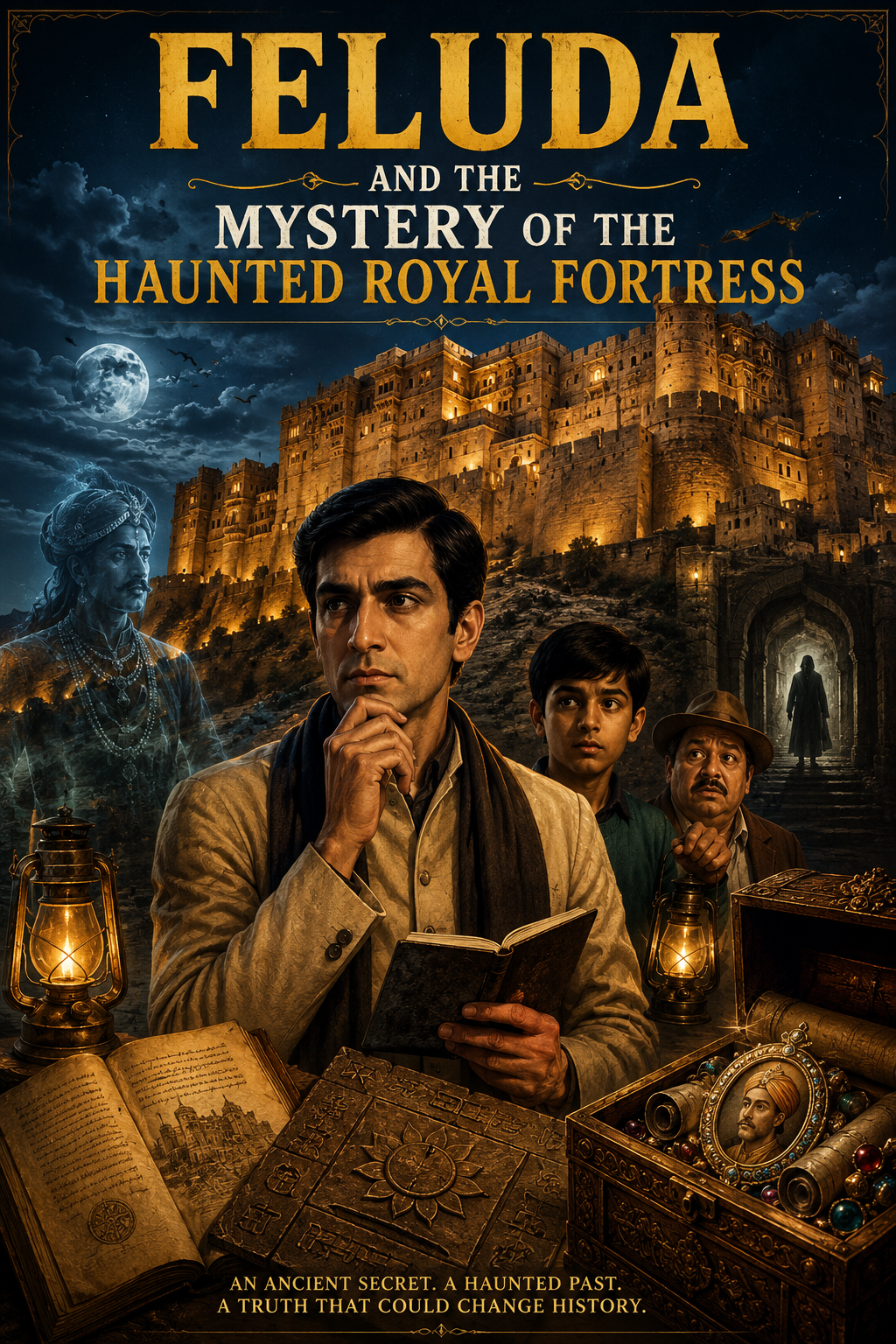
The golden city of Jaisalmer shimmered beneath the fierce Rajasthani sun like a mirage rising from the endless sands of the Thar Desert. From a distance, the Royal Fortress appeared less like a man-made structure and more like a colossal ship carved from honey-colored sandstone, sailing upon waves of dunes frozen in time. By day, it dazzled visitors with its ornate balconies, latticed windows, and towering bastions. But once darkness descended, another face of the fortress emerged. The laughter of tourists vanished, the alleys emptied, and stories whispered across generations returned with renewed life—stories of ghostly apparitions, echoing footsteps, and invisible guardians wandering the deserted corridors.
Such tales rarely impressed Pradosh Chandra Mitter, better known as Feluda.

His sharp intellect had demolished countless myths that others accepted without question. Yet when an urgent letter arrived from his old acquaintance, the eminent historian Dr. Raghav Sharma, even Feluda sensed that this case was unlike any other.
Dr. Sharma claimed he had uncovered evidence that could rewrite the history of Jaisalmer’s royal dynasty. Hidden beneath layers of folklore was the truth behind the mysterious disappearance of Maharawal Virendra Singh, the fortress’s last powerful ruler. But ever since discovering a collection of forgotten manuscripts, unexplained incidents had plagued him. His research room had been ransacked twice without anything valuable being stolen. Anonymous notes warned him to abandon his work. Strange lights floated across the fortress after midnight, while locals swore they had heard anguished voices drifting from abandoned chambers.
“I fear someone wishes history to remain buried,” the historian had written. “Whether man or ghost, I cannot say.”
Curiosity, more than belief in the supernatural, brought Feluda to Rajasthan.
Accompanied by Topshe and the ever-enthusiastic Lalmohan Ganguly—better known as Jatayu—the trio arrived in Jaisalmer on a warm autumn afternoon. The city glowed in shades of amber beneath the desert sky, its narrow streets alive with camel carts, folk musicians, spice merchants and craftsmen chiseling intricate patterns into sandstone.
Even Jatayu, normally quick with exaggerated observations, stood speechless.
“It looks,” he finally declared, “as though someone built an entire city from melted gold.”
Feluda smiled.
“Appearances are often deceptive.”
Dr. Sharma lived in a modest haveli overlooking the fortress. Shelves overflowed with manuscripts, maps, miniature paintings and archaeological sketches. The historian himself looked exhausted. Dark circles surrounded his eyes, and he glanced nervously toward every window while speaking.
He described hearing footsteps in empty rooms, discovering fresh footprints where centuries of dust had lain undisturbed, and waking repeatedly to the sound of metal chains scraping across stone.
Most unsettling of all was the disappearance of one crucial manuscript—a Persian chronicle describing the final days of Maharawal Virendra Singh. The thief had ignored priceless antiques and stolen only those pages.
Feluda asked quiet, precise questions.
Who knew of the manuscript?
Which scholars had visited recently?
Had anyone attempted to purchase his research?
Dr. Sharma mentioned an antique dealer named Mahendra Rathore who had repeatedly offered substantial sums for unpublished documents. There had also been Professor Iqbal Hussain, an epigraphist from Jaipur, and a wealthy businessman funding “heritage conservation” projects.
Feluda noted every name.
That evening they entered the Royal Fortress.
The ancient gates groaned as though awakening from centuries of slumber. Wind whistled through deserted courtyards. Oil lamps flickered outside temples while distant bells echoed across silent walls.
A local guide refused to accompany them after sunset.
“The spirits walk freely after dark,” he warned. “No amount of money can persuade me otherwise.”
Feluda merely thanked him and continued inside.
The fortress resembled a maze. Narrow staircases climbed unexpectedly into balconies overlooking vast courtyards. Secret balconies connected royal apartments with hidden observation points. Every corridor seemed designed both for beauty and defence.
As they explored, Feluda noticed several unusual details.
Fresh candle wax stained ancient stone.
A modern leather boot print crossed centuries-old dust.
Someone had recently forced open a forgotten storage room.
Ghosts rarely wore leather boots.
The grand audience hall remained remarkably intact.
Magnificent murals depicting royal processions covered its walls. Massive sandstone pillars supported intricately carved ceilings where peacocks, elephants and celestial dancers appeared frozen in graceful motion.
Yet one section of wall caught Feluda’s attention.
Beneath faded paint were symbols unlike ordinary decorative motifs. They resembled coded markings rather than artistic flourishes.
Using tracing paper, Feluda copied every symbol into his notebook.
Nearby lay tiny scratches around a carved lotus.
“Someone has been searching here,” he murmured.
Topshe examined the stone.
“It looks as though they tried to pry it open.”
“But failed.”
Feluda’s eyes sparkled.
“Which means they didn’t understand the mechanism.”
The following morning, they visited the city archives.
Hours passed as Feluda compared inscriptions with forgotten manuscripts written in Sanskrit, Persian and old Rajasthani dialects.
Finally he found the answer.
The mysterious symbols represented astronomical positions rather than letters.
When aligned according to a rare planetary conjunction recorded during Maharawal Virendra Singh’s reign, they formed a directional map pointing toward the royal quarters.
The carvings were not decoration.
They were instructions.
Before they could investigate further, another development altered the case.
Dr. Sharma vanished.
His study was found overturned. One chair lay broken beside an open window. On the desk rested only a single piece of parchment bearing an ancient Rajput emblem and the words:
“Leave the fortress before the next full moon.”
The police suspected kidnapping.
Locals insisted the spirits had claimed another victim.
Feluda believed neither.
Examining the room, he noticed grains of unusually fine desert sand trapped beneath the carpet. Nearby rested a fragment of blue silk embroidered with silver thread.
Hours later, while visiting Mahendra Rathore’s antique shop, Feluda saw identical silk covering several expensive manuscripts imported from Central Asia.
The dealer remained calm under questioning, but his nervous hands betrayed him.
That night, Feluda returned alone to the audience hall.
Using the astronomical sequence, he pressed specific carved symbols surrounding the lotus.
Nothing happened.
He paused.
Then noticed one symbol had been restored recently using fresh mortar.
Someone had deliberately altered the mechanism.
Carefully scraping away the repair revealed another hidden indentation.


The moment he pressed it, the enormous lotus rotated silently.
A section of floor slid aside.
Cold air rushed upward from the darkness below.
Armed with lanterns, the three descended the ancient staircase.
The underground passages stretched far beneath the fortress, supported by massive stone arches. Hidden ventilation shafts carried faint currents of cool desert air. Bats fluttered overhead while droplets echoed somewhere deep within the labyrinth.
Ancient torches still occupied wall brackets blackened by centuries of smoke.
The tunnels eventually opened into an enormous vaulted chamber.
Its walls displayed magnificent frescoes depicting scenes absent from official royal history.
Not victories.
Executions.
Secret trials.
Political assassinations.
The paintings told the story of Maharawal Virendra Singh’s increasingly paranoid reign. Trusted ministers had been imprisoned. Innocent nobles accused of treason disappeared without trial. Entire families vanished into underground dungeons.
History had celebrated a heroic king.
The murals revealed a tyrant.
At the chamber’s center stood an elaborately carved sandstone chest.
But Feluda ignored it.
Instead, he examined the floor.
Fresh footprints surrounded the chest.
Someone else had already reached it.
Suddenly lantern light flashed behind them.
Mahendra Rathore emerged with three armed accomplices.
“So,” he smiled, “the famous detective solved the puzzle for me.”
The antique dealer confessed that he had spent years searching for the legendary Royal Archive, believing it concealed priceless jewels. After bribing officials and intimidating researchers, he had learned of Dr. Sharma’s discoveries.
The historian was alive—but imprisoned elsewhere inside the tunnels.
“You may keep your history,” Rathore sneered.
“I only want what it can buy.”
He ordered his men forward.
Feluda remained perfectly calm.
“You’ve misunderstood the treasure.”
Rathore laughed.
“We shall see.”
He forced open the sandstone chest.
Inside lay no diamonds or gold.
Instead rested dozens of scrolls sealed within copper cylinders, royal decrees, diplomatic correspondence, jeweled ceremonial insignia and one exquisite silver locket bearing the royal crest.
Rathore’s disappointment quickly turned into rage.
“This is worthless!”
“On the contrary,” Feluda replied.
“It is priceless.”
The archive contained irrefutable evidence proving generations of official history had concealed the ruler’s crimes. The manuscripts exposed conspiracies, illegal executions and the names of innocent families destroyed for political ambition.
The silver locket held a miniature portrait—not of the king, but of his younger brother, believed to have died in battle.
According to the documents, the brother had actually led a peaceful rebellion against the tyrant before disappearing inside the fortress.
His descendants had lived anonymously ever since.
The true treasure was truth itself.
Enraged, Rathore attempted to seize the documents.
At that instant the chamber echoed with the sound of approaching footsteps.
Police officers flooded the tunnel.
Earlier, anticipating betrayal, Feluda had quietly informed the local superintendent of his suspicions and marked the entrance to the hidden passage.
Within minutes Rathore and his accomplices were arrested.
Dr. Sharma was rescued from a locked storage chamber nearby, weak but unharmed.
Over the following weeks, historians carefully examined the underground archive.
Every document authenticated Feluda’s conclusions.
The fortress had never been haunted by restless spirits. The mysterious lights were lanterns carried by smugglers searching for the archive. The ghostly whispers were produced by desert winds traveling through hidden ventilation shafts. Footsteps belonged to treasure hunters using forgotten passages.
Yet something deeper lingered within those ancient walls.
Not ghosts.
Memory.
Centuries of buried injustice had silently waited for someone willing to uncover the truth.
Dr. Sharma published the complete findings, ensuring that the forgotten victims of Maharawal Virendra Singh finally reclaimed their rightful place in history. The underground chamber was preserved as an archaeological site rather than stripped of its treasures.
On their final evening, Feluda, Topshe and Jatayu stood atop the fortress walls as the setting sun bathed Jaisalmer in molten gold. Temple bells drifted across the desert while cool winds replaced the day’s relentless heat.
Jatayu gazed thoughtfully at the ancient citadel.
“So,” he asked, “there were no ghosts after all?”
Feluda looked once more at the weathered ramparts glowing against the crimson horizon.
“Every old fortress has ghosts,” he replied quietly. “They simply aren’t made of spirits. They’re made of forgotten truths. And those are often far more dangerous.”
As darkness settled gently over the Golden City, the Royal Fortress no longer seemed haunted.
It stood instead as a monument to history—its deepest mystery solved not by superstition, but by observation, patience, and the relentless pursuit of truth that had always defined Feluda.












 https://www.youtube.com/watch?si=RtToJsBhYBatUrym&v=mOuYNSdhjHA&feature=youtu.be